15 December 2025
Top 11 AI Visibility Tools for LLMs Brand Monitoring
Have you noticed your traffic dipping even though your rankings haven’t really moved? You’re definitely not the only one.
Tools like ChatGPT, Perplexity, and Google’s AI Overviews are now giving people quick answers—often the same answers they used to click through to your site to get.
And if your brand isn’t showing up in those AI-generated answers, you’re probably losing visibility—without any obvious way to measure it. Traditional analytics can’t tell you when an LLM mentions you or when it skips over you entirely.
That’s where AI visibility tools step in. They show you when and where your brand appears in AI answers, how often you’re mentioned, and whether your content is being cited at all.
Think of them as a way to track how well your content shows up across large language models and AI-driven search.
The good news? Several tools are already doing this. Some SEO platforms have added AI visibility features, while others focus only on tracking LLM citations.
Each one gives you a different way to monitor—and improve—how your brand shows up in AI.
In this article, we’ll walk through the top 11 AI visibility tools available right now so you can figure out whether LLMs are recommending your brand or ignoring it.
Let’s dive in!
What is an AI Visibility Tool?
AI visibility tools are software that help you see how your brand, content, or products appear in AI-generated search results—like Google’s AI Overviews, ChatGPT, or Perplexity.
They track mentions, citations, sentiment, and overall share of voice, much like SEO tools do for regular search.
By showing how often and how accurately your brand appears in Large Language Model answers, these tools help businesses spot gaps, stay consistent, and stay competitive in this new era of AI-driven search.
Why Are AI Visibility Tools Important?
Search behavior is changing fast. Gartner expects traditional search traffic to drop by 25% by 2026 as more people turn to AI tools and virtual assistants, fueling the zero-click trend.
Instead of clicking links, users get answers directly from AI platforms. That makes it just as important to understand how your brand appears in AI responses as it is to track Google rankings.
AI monitoring tools help by showing when LLMs mention your brand or use your content, and how those mentions shift over time. They work like Google Analytics for AI search, revealing which content earns citations and what gets ignored.
Standard SEO metrics still matter, but they no longer tell the full story. A growing share of your audience engages with your content through AI platforms, even without visiting your site.
Combining traditional analytics with AI visibility data gives you a clearer picture of your content’s reach and what truly drives results across channels.
What to Look For in an LLM Tracking Tool?
A lot of LLM-tracking tools look great at first, but once you spend a little time with them, the shine wears off.
Most stumble in the same ways: their scraping breaks easily, their coverage is thin, or their dashboards look slick but don’t actually help you spot anything useful.
Here’s what really matters:
- Real Scale: You want a tool that can handle thousands of prompts—not just via API, but straight from the UI. Otherwise, you’ll miss important outputs, such as tables or maps.
- Multi-Engine Coverage: Tracking ChatGPT alone isn’t enough anymore. The stronger platforms also watch Google AI Mode, AI Overviews, Perplexity, Claude, and Copilot.
- Actionable Insights: Look for model, topic, and sentiment breakdowns. Extra points if the tool highlights missed opportunities or easy wins.
- Roadmap Momentum: Check how fast the team is shipping. If progress feels slow, it’s usually a red flag.
- Global Support: If you need multiple languages or market-level insights, make sure the tool can actually deliver.
- Enterprise Readiness: Strong support, clean data policies, and stability to scale with your needs.
Pick something that checks these boxes, and you’ll avoid most of the usual headaches.
11 Top AI Visibility Monitoring Tools for 2026
Below are the best AI tools for improving online brand visibility:
1. Semrush
First up on our list of top AI visibility platforms is Semrush. It’s a true all-in-one setup that brings AI and SEO visibility together rather than treating them as separate worlds.
And honestly, that makes sense. If you want to know why ChatGPT or Google’s AI Mode talks about your brand the way it does, you can’t look at LLM outputs without also looking at the web signals those models pull from.
Semrush handles this with three different ways to dig into AI search data, each offering its own level of depth:
Semrush AI Visibility Toolkit
This is the quickest way to see how your brand shows up across ChatGPT, Google AI Mode, Gemini, and Perplexity.
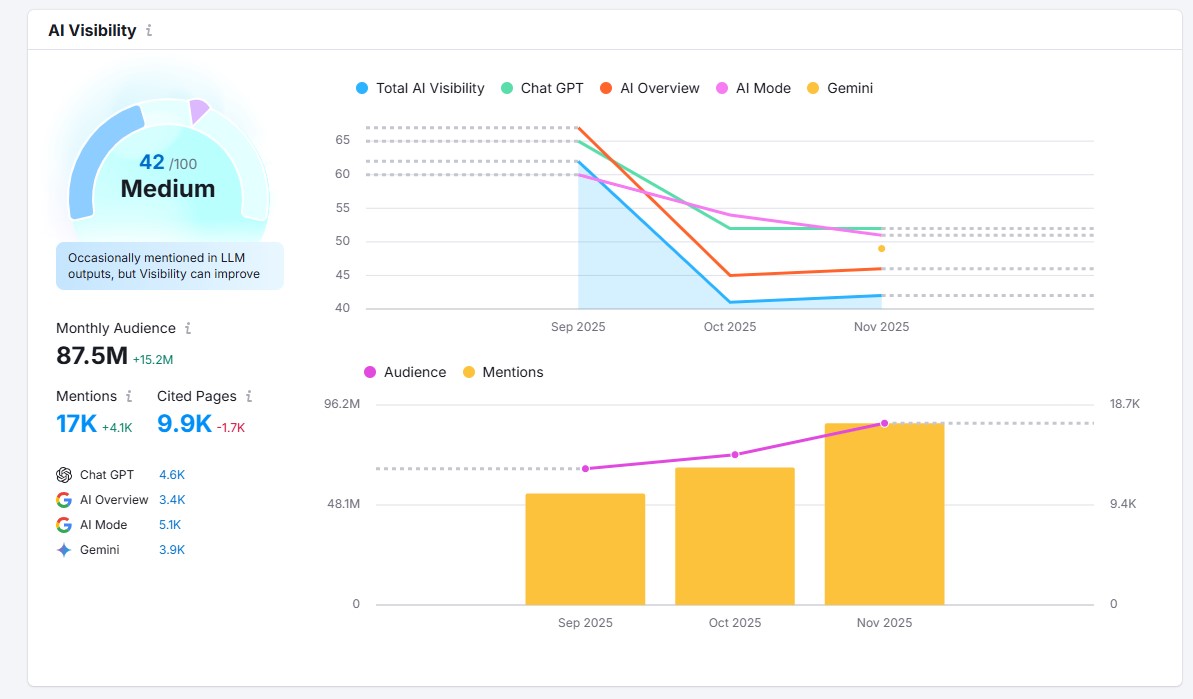
You can tap into Semrush’s huge AI search database—over 213 million prompts across 142 regions—to find where your brand is already appearing and track the prompts that matter most to you.
Daily tracking (up to 25 prompts) makes it easy to spot trends, wins, and gaps.
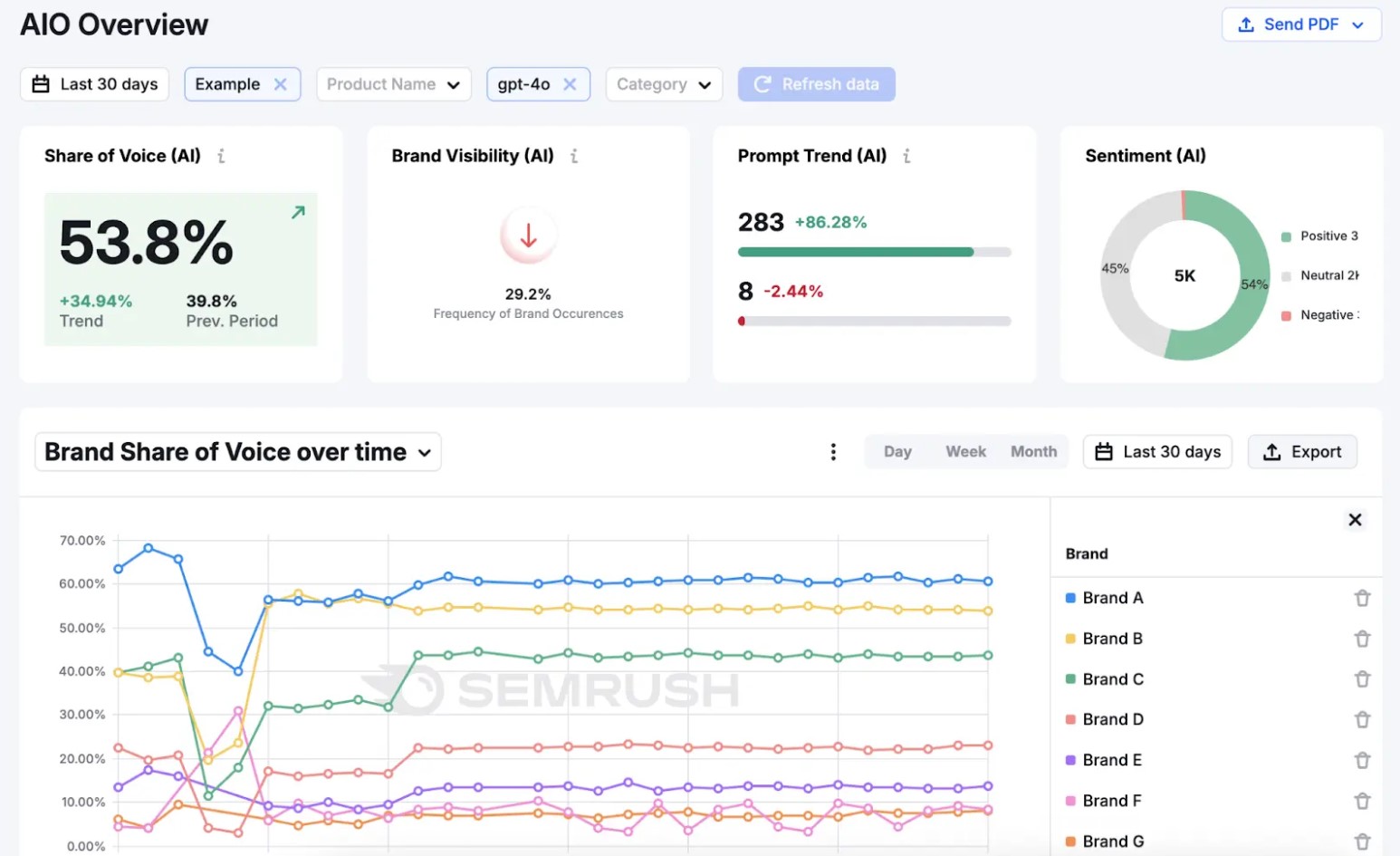
The standout feature is the Brand Performance Report. It shows your Share of Voice, sentiment, and even the exact domains and URLs LLMs reference when they mention your brand.
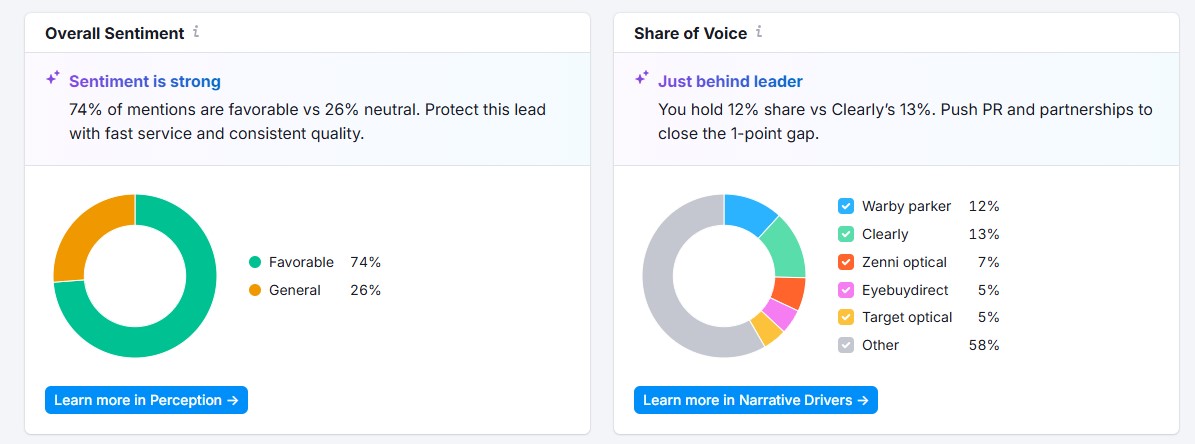
If you want a single, clean view that shows where you appear, where you don’t, and what’s driving it, this is the one to use.
Semrush One
Semrush One combines the full SEO Toolkit with the AI Visibility Toolkit, which is the setup most marketers will use in 2025.
You get everything—keyword data, backlinks, competitor analysis, content optimization, technical audits, and AI visibility—all tied together in one place.
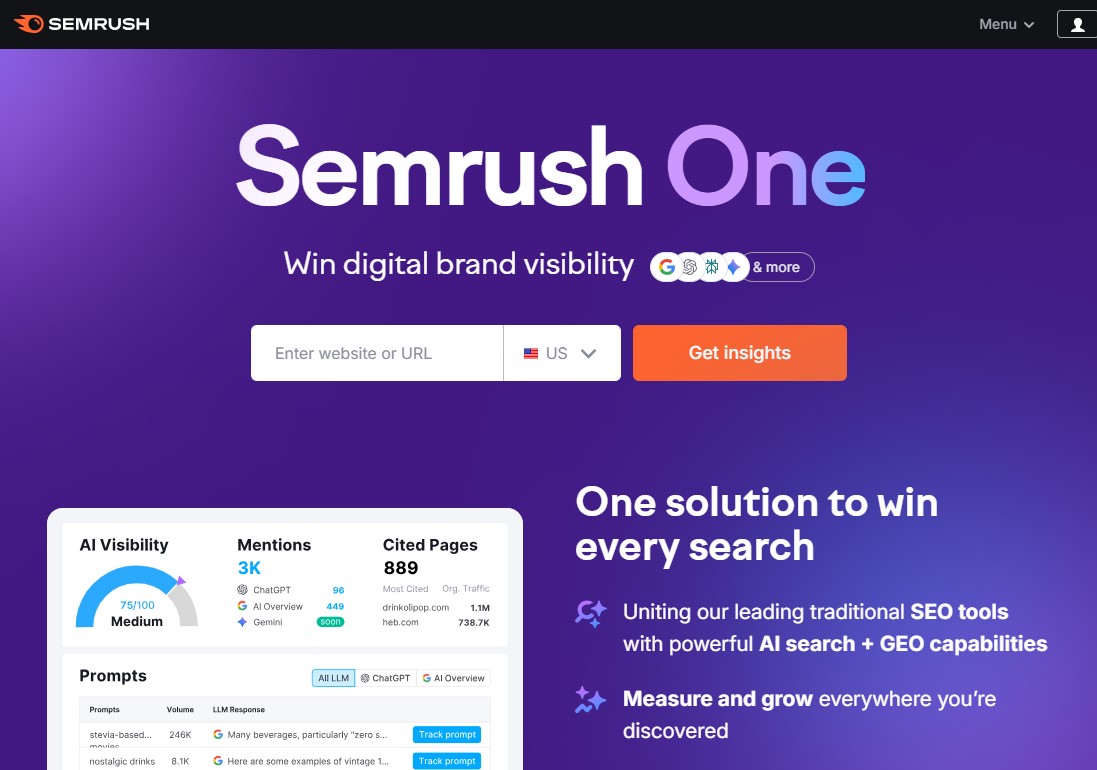
This gives you a complete picture: not just how AI platforms describe your brand, but the web signals behind those answers.
If you want one subscription that handles search from end to end, this is your best bet.
Enterprise AIO
Enterprise AIO is Semrush’s most advanced package for AI search data. It’s built for scale, supporting hundreds or even thousands of tracked prompts across all major LLMs.
It includes multi-brand reporting, regional breakdowns, and API access for custom dashboards. It’s designed for teams that need accuracy, historical data, and control—not just insights.
For agencies, it’s the easiest way to manage AI visibility for many clients at once. If you need enterprise-level depth or you’re overseeing visibility at scale, this is the option built for you.
Yes, it costs more.
But it’s also the most complete product available today for LLM visibility.
The reason is simple: Semrush has the infrastructure and scale that most companies don’t. After spending more than a decade building one of the strongest search visibility platforms, they’re now applying that expertise to AI.
Two features really stand out: Competitor Rankings and Market Analysis. Once you’ve set up your prompts and categories, you get a detailed look at your visibility across every LLM you track.
Plus, the source domains and URLs driving those mentions.
Key Capabilities:
- Track brands, products, and topics as they happen
- See sentiment scored right down to each quote
- Understand your Share of Voice across different LLMs
- Get clear insights on how each source domain and URL performs
- Automate your workflows and tap into powerful Semrush integrations
Pricing:
- AI Visibility Toolkit: It costs $99/month per domain.
- Semrush One: It starts from $199/month and includes the full SEO Toolkit + AI visibility in one plan.
- Enterprise AIO: Custom pricing for multi-brand, multi-region, and agency-scale visibility.
2. Profound

Profound is an all-in-one LLM visibility tool. You can use it to generate better prompts, monitor your visibility, compare yourself to competitors, track citations, and review optimization tips.
It also lets you see how bots move through your site and which pages they visit.
On top of that, Profound runs a large prompt database—called Prompt Volumes—that’s built from real user data, which makes it easier to craft more relevant prompts.
One standout feature is their ChatGPT Shopping tracking. It highlights the prompts that matter most so you have a better chance of appearing in AI-driven shopping results.
The Content Generation and Content Optimization tools are especially useful. They help you create new content or refresh what you already have based on the prompts you’re targeting. The suggestions follow best practices for improving LLM visibility.
Profound may track more answer engines than any other tool on this list. But you’ll need an Enterprise plan to access the full set: ChatGPT, Perplexity, Google AI Mode, Google Gemini, Microsoft Copilot, Meta AI, Grok, DeepSeek, Anthropic Claude, and Google AI Overviews.
With that range and capability, it makes sense that Profound comes with an enterprise-level price tag.
Key Capabilities:
- Prompt-level tracking + AI-generated prompt suggestions
- Visibility and Share of Voice by topic, region, and platform
- Citation logs with domain/page stats
- ChatGPT Shopping tracking for ecommerce brands
- Competitor benchmarking & branded answer analysis
Pricing:
The Profound Starter plan costs $99/month for ChatGPT only, with 50 prompts. If you want 10+ AI search engines and custom prompts, you can buy an Enterprise plan.
3. Otterly AI
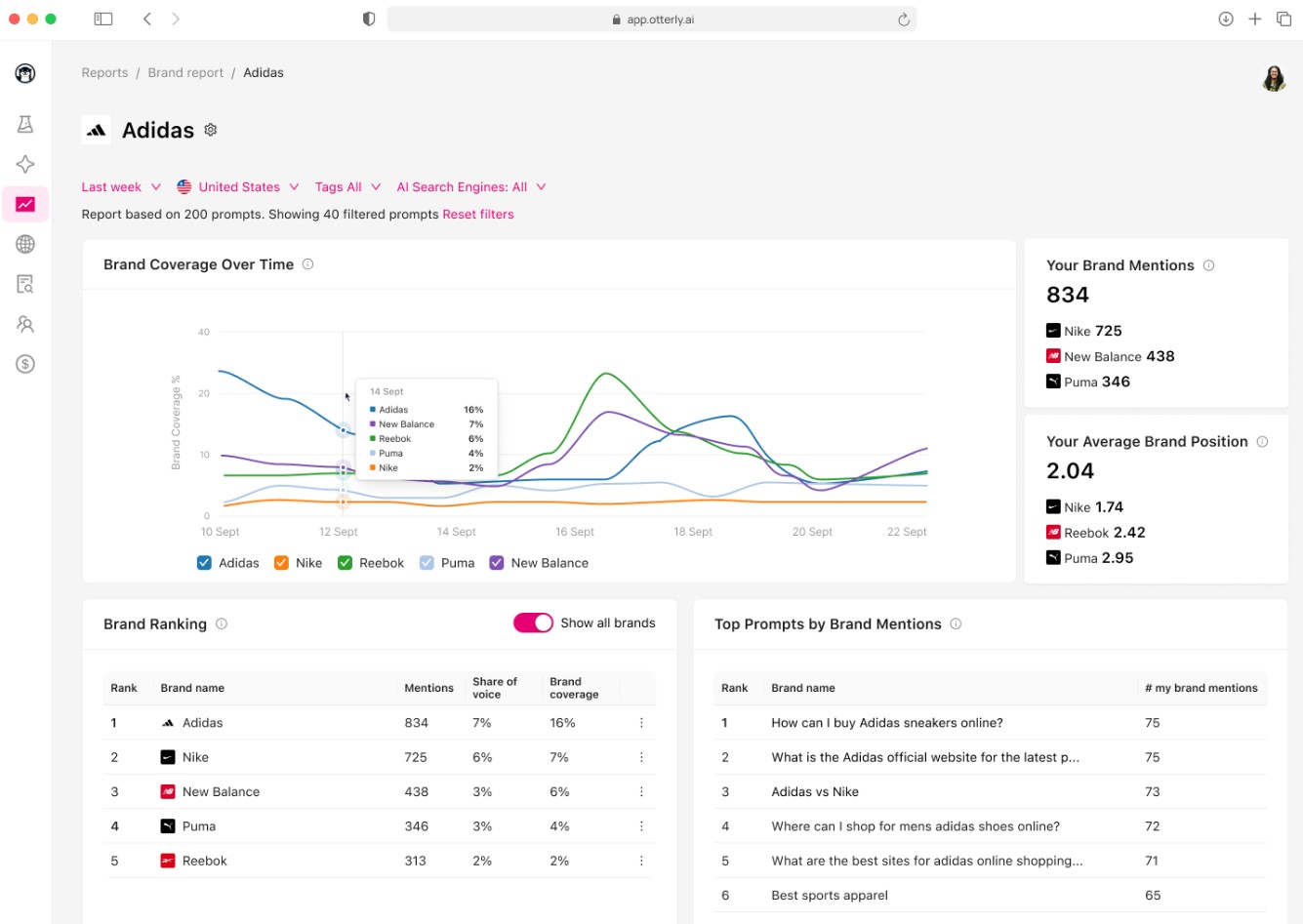
Otterly AI is a popular AI search monitoring and visibility tool used by more than 15,000 marketing professionals worldwide. It helps you see how your brand shows up in AI search tools like Perplexity, ChatGPT, Gemini, Copilot, and Google’s AI Overviews.
In short, it keeps an eye on your brand and your content across these platforms so you can prepare for Generative Engine Optimization (GEO).
The platform includes an AI keyword research tool. This helps you uncover the prompts people might use, so you can shape your content, boost visibility, and capture demand before your competitors do.
It also offers a GEO audit feature that shows you how to improve your existing content for better visibility in large language models. The audit reviews more than 25 on-page factors to highlight what you’re doing well, point out gaps, and help you strengthen your brand’s presence in AI search.
That said, it’s missing a few pieces if you’re looking for a full LLM monitoring solution. It doesn’t provide data-driven recommendations or trend insights, and it doesn’t offer visibility analysis from an AI crawler’s perspective.
Still, the real value of Otterly AI is that it’s affordable, easy to use, and simple to get started with. Even without every advanced feature, it gives you several practical ways to track and improve your brand’s visibility in AI search.
Key Capabilities:
- Brand & competitor mention tracking with sentiment
- Citation/link detection across AI responses
- Converts traditional SEO keywords into conversational search prompts
- Automatic daily/weekly prompt runs + alerts
- GEO Audit Tool to assess readiness and authority for AI search indexing and citation
Pricing:
Plan starts at $29/month for 15 search prompts. An additional 100 search prompts are available as an add-on for an extra $99 per batch. A 14-day free trial is also available.
4. Peec AI
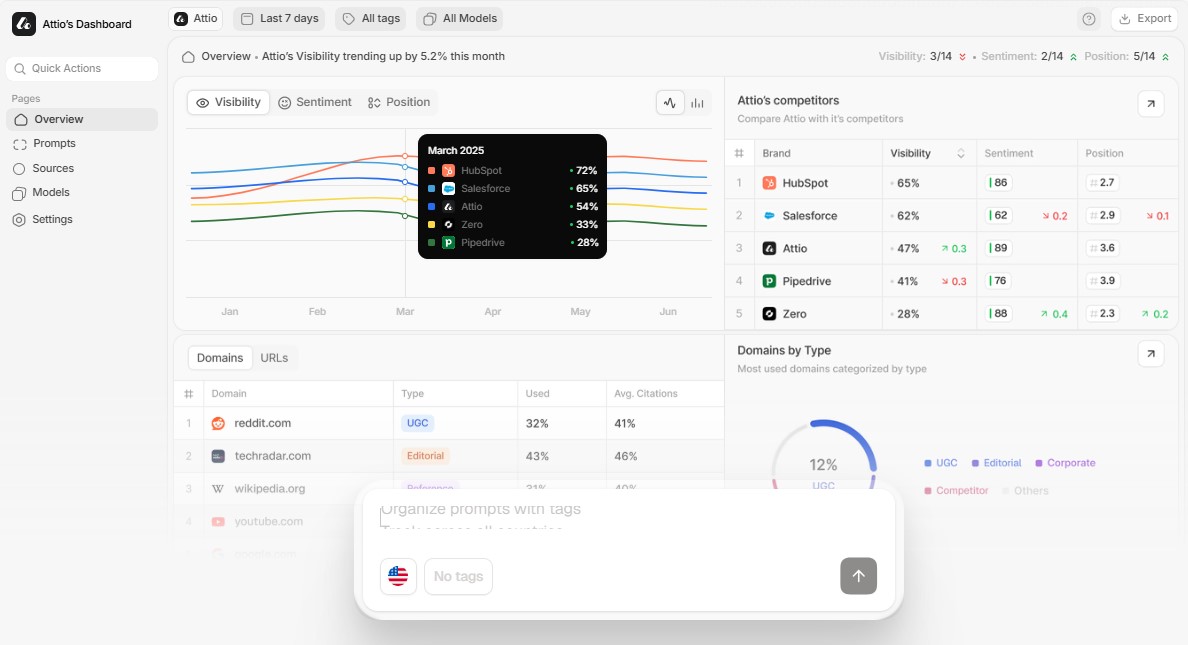
Peec AI is a visibility analytics tool that shows how your brand appears in AI-generated responses from models like ChatGPT, Perplexity, Gemini, and Claude. Instead of looking at search engine rankings, it tracks when your brand is mentioned, where it appears, and how it’s being referenced in those responses.
The platform also breaks down trends over time. It looks at which prompts spark mentions, how often your brand appears, and which sources the models rely on when citing your content. This helps you see which pages or domains are actually driving those appearances.
In short, Peec AI gives you a clear picture of your presence inside AI outputs—who gets cited, who gets overlooked, and how visibility shifts as prompts or models change.
Key Capabilities:
- Tracks brand mentions, sentiment, and visibility across top LLMs
- Country-specific visibility insights (multi-language capable)
- Easy onboarding and export-friendly reports
- Modular pricing for expanding LLM coverage without overpaying
- Clean, modern UI with prompt-level reporting and tagging
Pricing:
Peec AI offer free trial to test it out. The Starter plan starts at €89/month for 25 prompts and access to 3 AI search platforms. Add-ons available for Gemini, AI Mode, Claude, DeepSeek, Llama, Grok, and others.
5. Scrunch AI
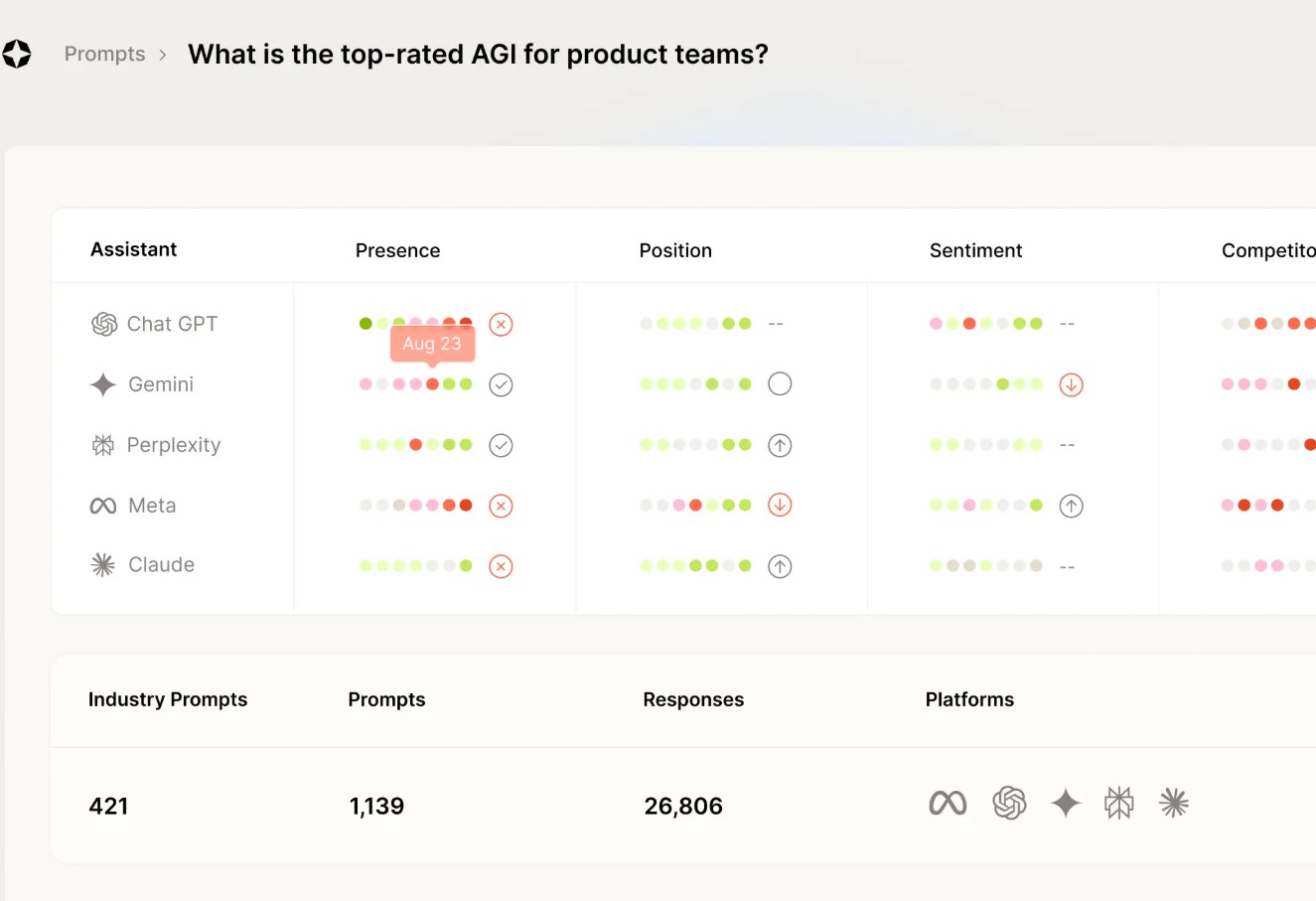
Scrunch AI is a monitoring-focused LLM visibility platform that helps you see how your brand shows up inside AI-powered search tools like ChatGPT, Perplexity, and Gemini. It focuses on monitoring, so you get a clear picture of what these systems are saying about you.
It checks your brand mentions every day, tracks sentiment, compares you with competitors, and even connects with Google Analytics GA4 to show where AI crawler traffic is coming from.
The platform also looks at the full AI-driven customer journey. It highlights missing content, flags misinformation, and points out areas you can improve.
However, its competitor analysis and actionable insights aren’t as strong as those of other platforms.
One standout feature is its Agent Experience Platform (AXP). This tool helps brands build an AI-friendly, machine-readable version of their site—sometimes called a “shadow site.” It lets you deliver clean, structured content directly to AI agents and large language models without changing anything on your actual website.
Key Capabilities:
- Multi-platform LLM visibility & citation tracking
- Compares your brand’s share-of-voice and visibility against competitors
- Persona-based prompt segmentation
- AXP (Agent Experience Platform) for AI-optimized content delivery
- misinformation detection and journey mapping
- Real-time bot traffic analytics
Pricing:
Starts at $300/month for 350 custom prompts and three personas. You can also try 7 days free trial.
6. Surfer SEO AI Tracker
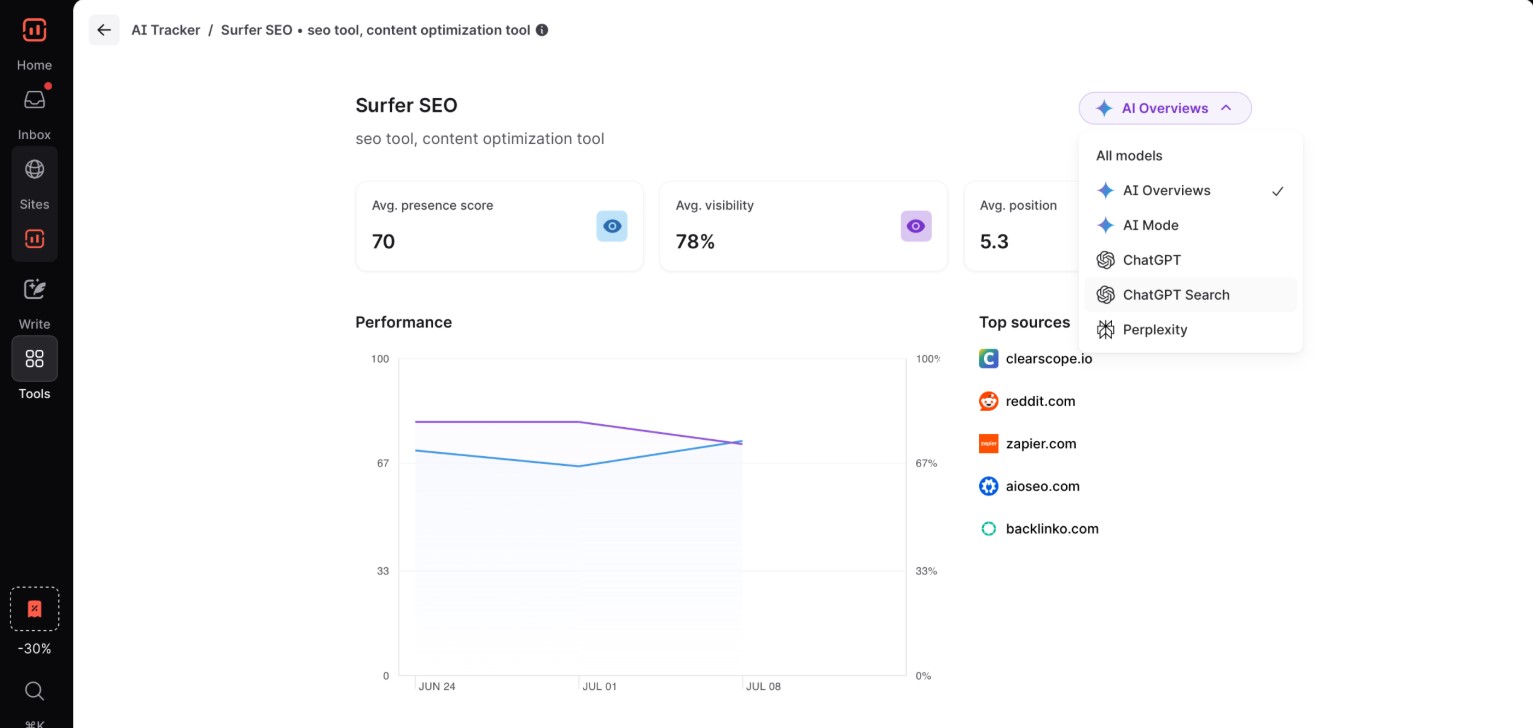
Surfer is a content optimization tool that helps you create blog posts and articles that rank well.
It does this by checking your page against more than 500 on-page signals. These include things like how relevant your content is and how well you cover the topic. Based on that, it gives you clear, data-backed suggestions to strengthen your content.
Surfer now also includes an AI tracker. This feature shows how visible your brand is across major LLMs such as Google’s AI Overviews, SearchGPT, Perplexity, Claude, and ChatGPT. It looks for mentions of your brand, products, and key topics so you can see when you appear in AI-generated answers.
The tracker is simple to set up. You add it to your Surfer plan, enter your brand and main topics, choose your language, and then review the suggested prompts. You can approve them as they are or make edits.
Overall, it is one of the best AI SEO tools available.
Key Capabilities:
- Brand‑mention tracking across five AI surfaces
- Prompt‑level insights
- Identify the specific web pages LLMs pull data from
- Find and fix mention gaps
Pricing:
Surfer AI tracker cost $95/month for 25 prompts.
7. SE Ranking
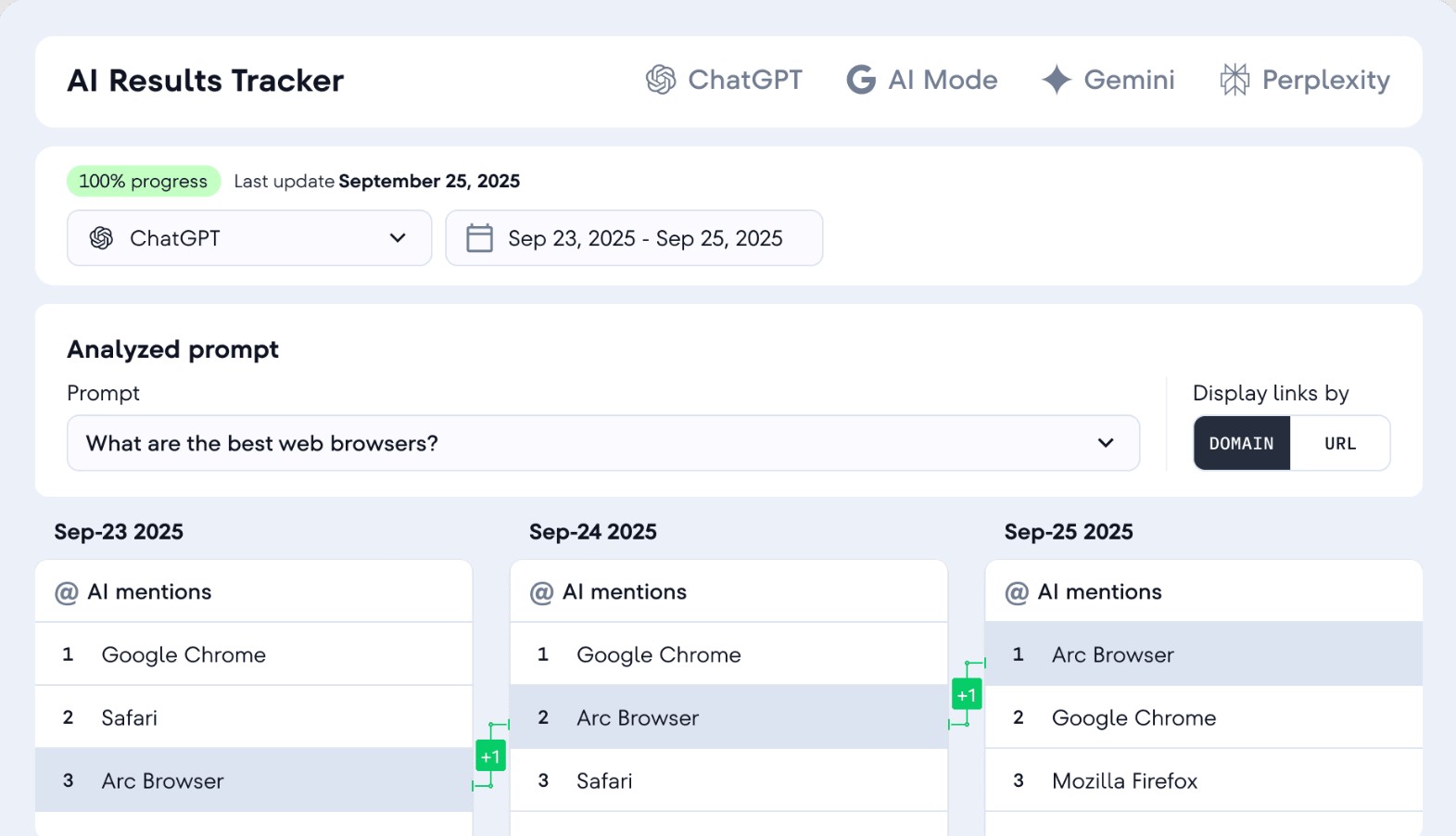
SE Ranking is an all-in-one, cheap SEO tool that covers both traditional SEO tasks and the newer world of AI visibility.
On the traditional side, you get keyword research, competitor analysis, backlink checking, content optimization, and plenty of other useful tools. As an AI visibility tool, it offer an complete AI search toolkit that shows how your brand appears across major AI search engines.
It tracks mentions and links and even lets you compare your visibility with competitors, so you can spot growth opportunities.
One standout feature is the AI Competitor Research tool. You can enter any domain and instantly see how that brand shows up on different AI platforms. It breaks down how often they’re mentioned, where they’re linked, and their average placement inside AI answer boxes.
This makes it much easier to see which topics or prompts your competitors are winning—and where you still have room to catch up.
Another important feature is the AI Results Tracker. It helps you monitor your visibility for the prompts that matter most to your business. You choose the queries, then track whether your brand is mentioned or linked. You can also see how your visibility changes over time compared to your competitors.
Overall, if you’re already using SE Ranking or looking for an SEO tool that also include AI visibility tracker, it’s a strong pick.
Key Capabilities:
- Track brand mentions across multiple AI engines
- Monitor website link citations within AI answers
- Benchmark brand visibility against key competitors
- Analyze prompt performance and historical trends daily
- Review full AI-generated answers for context
Pricing:
SE Ranking offers its AI search toolkit as an add-on, which costs $89/month for 200 tracked prompts.
8. Writesonic
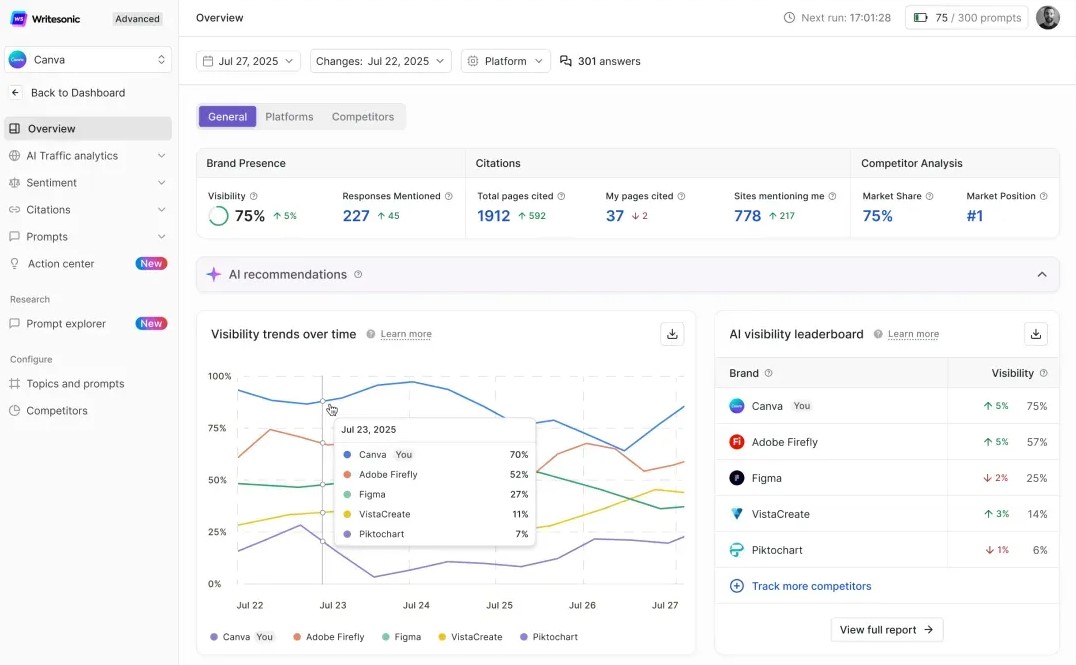
Writesonic blends content creation with GEO analytics. It helps you write, fine-tune, and track how your content shows up across various AI platforms.
You can see how often your content appears in AI-generated answers and which questions are triggering those mentions. It also highlights the sources that are cited most often.
If you spot a visibility gap, you can fix it right away. Use Writesonic’s built-in AI SEO tools and writing features to create optimized content on the fly.
This mix of insight and creation is what truly sets the platform apart.
Key Capabilities:
- Tracks how often your brand is cited across AI platforms
- Compare citations, visibility share, sentiments, and gaps
- Identifies citation gaps and opportunities for your content
- Monitor winning/losing prompts and discover opportunities
- Identify which URLs models are referencing
Pricing:
Paid plans start at $199/month.
9. Ahrefs Brand Radar
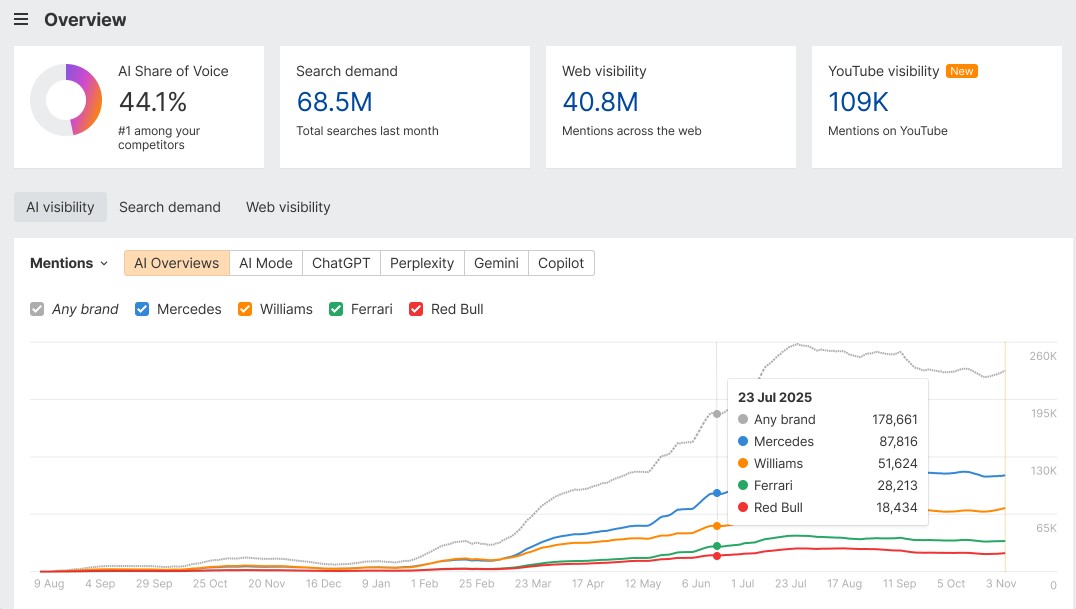
Brand Radar is one of the first all-in-one AI tools for tracking brand mentions across multiple AI platforms.
Most brand monitoring tools only look at what’s happening on the web. Brand Radar goes a step further. It digs into AI-generated answers—an area that’s still pretty new—and gives you insights that used to be almost impossible to gather at scale.
It also connects smoothly with the rest of the Ahrefs ecosystem. You’ll see AI citation data inside Site Explorer, along with dedicated modules for Search Demand and Web Visibility.
Because everything is in one place, you can review AI mention data right next to your usual SEO metrics. That makes it much easier to understand your brand’s overall visibility.
Furthermore, Brand Radar keeps track of when AI systems mention your brand or industry. It breaks down those mentions to show how visible you are compared to your competitors. You can spot gaps in AI visibility, uncover LLM trends, and find new opportunities in the market.
Key Capabilities:
- Identify content gaps where competitors appear, but they don’t
- Discover new topics and questions driving brand mentions
- Benchmark share of voice in AI results
- Develop AI-optimized content strategies
- Reports brand mentions across YouTube and Reddit visibility
- Groups millions of AI prompts into relevant topic clusters
Pricing:
Available as an add-on to your existing Ahrefs plan for $199/month.
10. Rankscale
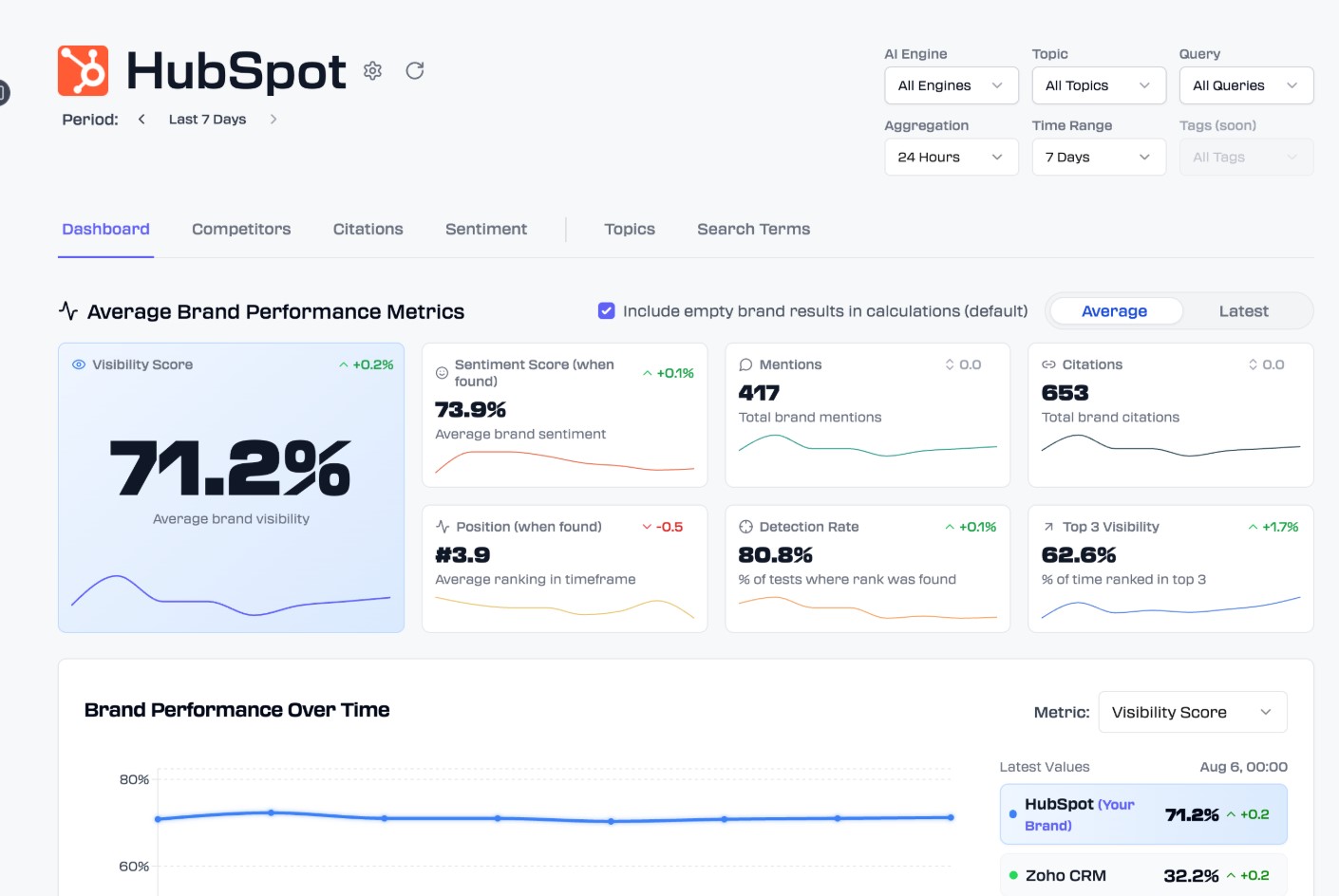
Rankscale is an affordable AI visibility and Generative Engine Optimization platform that helps brands understand how they appear across major AI search engines. That includes ChatGPT, Google Gemini, Claude, Perplexity, Mistral, and Grok.
It examines how these models read a site’s content, authority, sentiment, and citations, then highlights gaps and opportunities for improvement.
The platform offers website audits that outline AI readiness scores, content performance, and clear paths for optimization. You can analyze a single page or run a multi-page crawl to spot weaknesses.
It also lets you compare your current content with updated, AI-optimized versions. On top of that, RankScale tracks sentiment across different AI engines so you can understand how each one perceives your brand in various search topics.
It also includes competitor benchmarking. This shows how other brands stack up across the same AI engines and highlights differences in visibility, sentiment, and how often they’re cited.
Key Capabilities:
- Analyze content citations and authoritative source links in AI
- Identify content gaps where competitors dominate AI search results
- Track brand mention frequency and overall visibility over time
- Generate actionable recommendations to optimize content for AI visibility
- Benchmark competitor visibility and brand sentiment within AI answers
Pricing:
Plan starts at $20/month with monthly credits. Free trial available on request.
11. Nightwatch
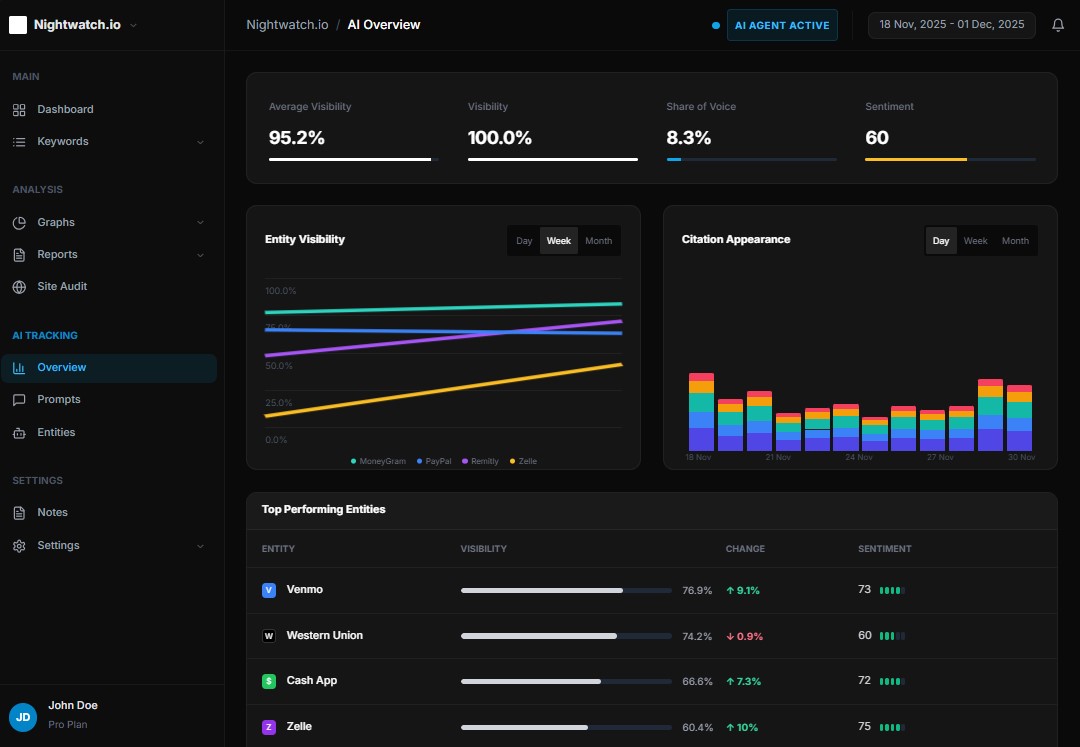
Nightwatch is a complete platform for tracking both SEO and AI visibility. It keeps an eye on your keyword rankings worldwide and monitors a wide range of SERP features—such as organic results, snippets, local packs, AI snippets, image carousels, and knowledge panels.
It also includes AI-tracking tools that show how your content appears inside answers from systems like ChatGPT, Claude, Gemini, and others.
In short, it connects classic SEO with the growing world of AI search. You can see how you rank on Google and how you show up when people ask questions through AI-powered assistants.
Key Capabilities:
- Track AI Overview visibility and generative search rankings daily
- Measure AI Share of Voice against key competitors effectively
- Analyze exact source URLs cited by Large Language Models
- Identify and track brand sentiment within AI-generated answers
- Analyze performance for specific user-configured conversational prompts
- Unify traditional SEO rank tracking with new AI visibility data
Pricing:
Nightwatch AI tracking add-on costs $99/month for 100 prompts.
Conclusion
AI search isn’t slowing down. In fact, it’s spreading everywhere. More platforms now answer users’ questions before they ever click a link.
That means keeping track of how often you show up in those AI-generated responses has become essential.
The AI visibility tools covered here provide visibility into how AI platforms cite your content and mention your brand. Some integrate AI monitoring & tracking into broader SEO platforms.
Others focus only on LLM citations. The right pick comes down to your budget, your workflow, and what you’re already using.
If you haven’t started tracking your AI visibility yet, now’s the time. The brands paying attention today will have a clear advantage over those that try to catch up later.
The tools are ready. The data is there. Put it to work.
For more, check out these other helpful resources:
- How to Rank in ChatGPT Search: 6 Actionable Tips
- 10 Best AI SEO Tools to Use in 2026 [Content + AI Visibility]
Lastly, follow us on Facebook and X (formerly Twitter) to stay updated on the latest WordPress and blogging-related articles.
Frequently Asked Questions
Are GEO and SEO the Same?No, they’re not the same thing. SEO is all about ranking well on a traditional search results page. GEO, on the other hand, is focused on visibility inside AI-generated answers and making sure your content gets mentioned or cited there.
No, they’re not the same thing. SEO is all about ranking well on a traditional search results page. GEO, on the other hand, is focused on visibility inside AI-generated answers and making sure your content gets mentioned or cited there.
How to Track AI Visibility?You can keep an eye on how visible your brand is in AI tools by using AI visibility platforms. They run prompts across different AI answer engines and check what shows up. These tools track brand mentions and break down the responses in a clear way. They also store past data, so you can see how your brand’s visibility changes over time.
You can keep an eye on how visible your brand is in AI tools by using AI visibility platforms. They run prompts across different AI answer engines and check what shows up. These tools track brand mentions and break down the responses in a clear way. They also store past data, so you can see how your brand’s visibility changes over time.
Do You Need AI Optimization If You Already Rank in Google?es. Just ranking on Google isn’t enough anymore. AI tools like Google AI Overviews and other AI search platforms don’t always use the top-ranked pages. They often pull answers from different sources. That’s where AI optimization comes in. It helps your content show up in AI-generated answers and improves how you perform across AI-driven search results.
es. Just ranking on Google isn’t enough anymore. AI tools like Google AI Overviews and other AI search platforms don’t always use the top-ranked pages. They often pull answers from different sources. That’s where AI optimization comes in. It helps your content show up in AI-generated answers and improves how you perform across AI-driven search results.
How Can I Benchmark My AI Visibility Against Competitors?A lot of AI search optimization tools let you keep an eye on your competitors. They show how your brand stacks up in terms of visibility, mentions, and search rankings. By looking at this data, it becomes easier to spot gaps and figure out where your brand can do better in AI-powered search results.
A lot of AI search optimization tools let you keep an eye on your competitors. They show how your brand stacks up in terms of visibility, mentions, and search rankings. By looking at this data, it becomes easier to spot gaps and figure out where your brand can do better in AI-powered search results.
What is the Best AI Optimization Tool for Visibility?The right AI visibility tool really comes down to what your business needs. Big enterprise brands usually lean toward tools like Semrush or Profound. Mid-sized companies, on the other hand, often find Scrunch AI or Peec AI to be a better fit.
If you’re looking for something that does more than just tracking, Writesonic or Surfer stands out. They handle both monitoring and optimization in one place. You can see how visible you are and actively work on improving it. Think of it as a mix of GEO and SEO that covers the whole process from start to finish.
The right AI visibility tool really comes down to what your business needs. Big enterprise brands usually lean toward tools like Semrush or Profound. Mid-sized companies, on the other hand, often find Scrunch AI or Peec AI to be a better fit.
If you’re looking for something that does more than just tracking, Writesonic or Surfer stands out. They handle both monitoring and optimization in one place. You can see how visible you are and actively work on improving it. Think of it as a mix of GEO and SEO that covers the whole process from start to finish.
